
PAINTINGS
Painting is a physical and time based process. Push and pull, moving about this way, no that way, closer, farther
so as to see, so as to know.
An array of paintings where apparitions and interstices of representation and abstraction encountered 'in situ' were 'rendered' from 2007 to 2024
in studios in Canada, the United States and Scotland.
Promised Land
Terre Promise
應許之地
Une série de paysages dépouillés dont la première lecture apparaît comme un rappel de lieux déjà vus et connus. Le voyage des Terres Promises témoigne, avec l'artiste, d'une réflexion et d'une image de la Terre Promise à distance de son étroite corrélation avec le pouvoir et la subjugation. JanBaetens, commentant Landscape and Power de WJT Mitchell, souligne que « le paysage porte inévitablement la trace des luttes de pouvoir, en particulier des luttes hégémoniques pour la détermination du sens ». Détenir le pouvoir du paysage ne signifie pas nécessairement « posséder physiquement » la terre - bien que cela arrive et même plus souvent qu'à son tour, mais avoir le droit et la possibilité d'imposer par représentation interposée une certaine vision du paysage. Dans la série des Terres promises, le paysage est rendu par de multiples couches spatio-temporelles superposées dans une séquence paradigmatique au sein de l'unicité du plan. Chaque tableau témoigne de l'aboutissement d'une quête, d'une aspiration. Comme la dernière image d'un récit cinématographique, la Terre promise nous invite à envisager le paysage comme un témoignage de l'éphémère.
A series of stripped-down landscapes of which a first reading appears as a recall of places already seen and known. The journey of the Promised Lands bears witness with the artist, to think and image the Promised Land at a distance from its close correlation with power and subjugation. JanBaetens, commenting on WJT Mitchell's Landscape and Power, points out that "the landscape inevitably bears the trace of power struggles, especially hegemonic struggles for the determination of meaning." To hold the power of the landscape does not necessarily mean to "physically own" the land – although it happens and even more often than in turn, but to have the right and the possibility to impose by interposed representation a certain vision of the landscape. In the series of Promised Lands, the landscape is rendered through multiple spatio-temporal layers superimposed in a paradigmatic sequence within the uniqueness of the plane. Each painting testifies to the culmination of a quest, a yearning. Like the last image of a cinematic narrative, the Promised Land invites us to envision the landscape as it bears witness to the ephemeral.


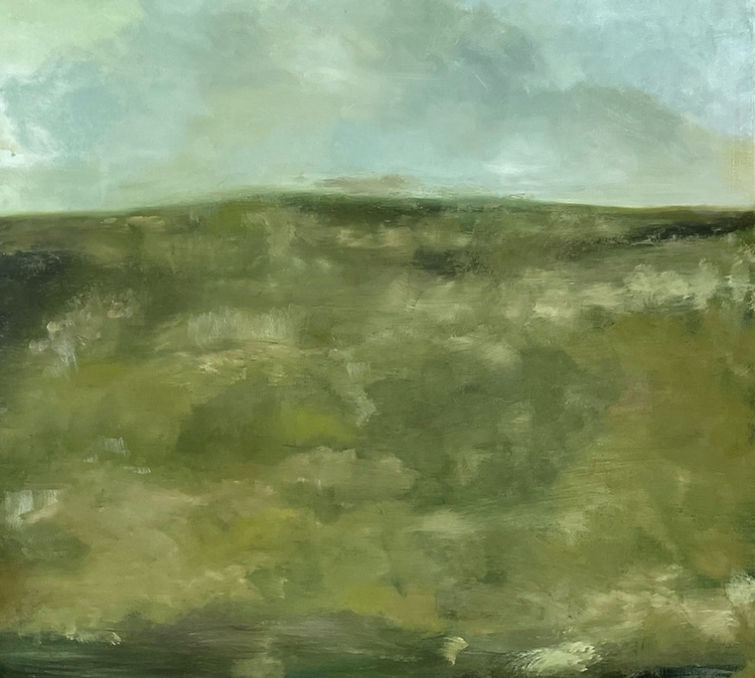

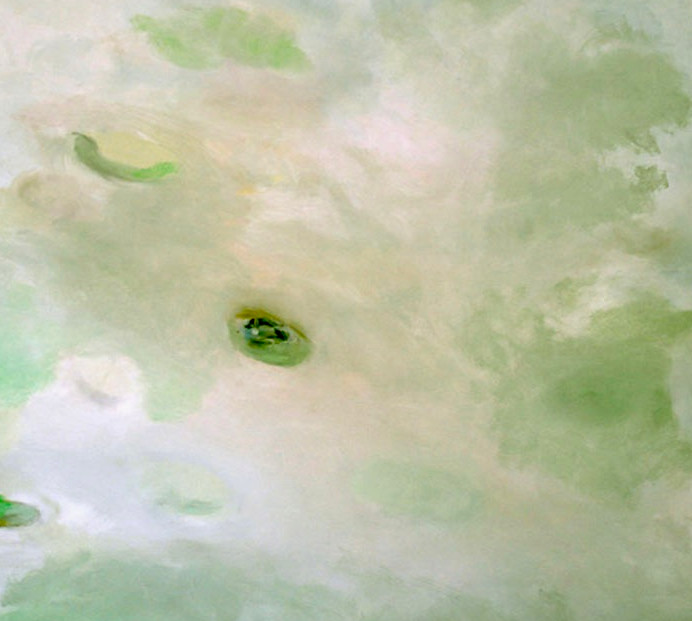

Canada, oil on canvas, 36''x42'', 2021
Australia, oil on canvas, 48"x48", 2011
Japan, oil on canvas, 48"x48", 2008
Monaco, oil on canvas,48"x48",, 2009
Germany, oil on canvas, 36"x36", 2008
Scotland, oil on canvas, 48"x48", 2008

Canada, oil on canvas, 48''x48'', 2022

West Croatia, oil on canvas, 48''x48'' 2020
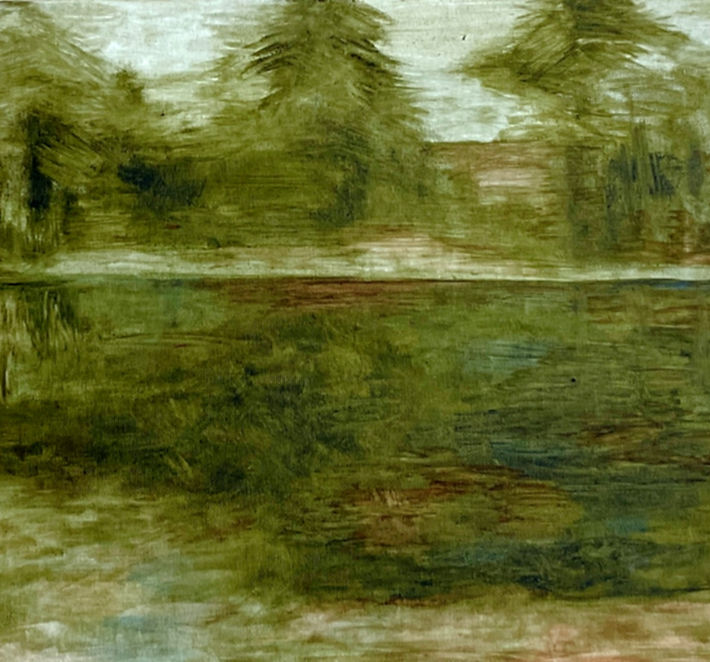
Cuba, oil on canvas, 20''x24''2021

Saint Andrews, Scotland oil on canvas 16''x24'', 2021

Italie, oil on canvas, 48''x48'' 2009

Spain, oil on canvas, 48''x48'', 2021

Italy, oil on canvas, 36"x36",2021

Greenock, Scotland, oil on canvas, 16''x24'', 2021
Parergons
相框
Suivant l'ancienne distinction, le sujet du tableau, l'ergon, est ici mis en relation plus étroite avec le parergon, c'est-à-dire le cadre, l'information visuelle subsidiaire de l'arrière-plan. C'est ainsi que Kant a catégorisé la division du travail bien connue selon laquelle le maître de la Renaissance peignait l'ergon, reléguant le parergon aux assistants.
En l'absence d'ergon explicite - oiseau, arbre, chien, figure humaine, bâtiment - une ambivalence palpable prévaut : est-ce l'Inconscient ? Du sublime ? Ici, même l'échelle et l'aspect sont incertains, car ce qui semble être de la « terre » pourrait plutôt être un autre matériau vu de près ou de loin.
...La démarche de Léa pour « fournir » le cadre ne doit pas être comprise comme une concession de quelque chose à la place de l'ergon absent. Elle signale le problème du cadre en le posant comme un champ de couleur sous-jacent qui précède et soutient l'image interne, qui est donc continue et n'est plus purement un ergon.
Dans La vérité en peinture, Jacques Derrida explique que « le parergon est une forme qui a pour détermination traditionnelle non pas de se distinguer, mais de disparaître, de s'enfouir, de s'effacer, de se fondre au moment où elle déploie sa plus grande énergie ». Poursuivant cette idée, elle affirme que l'ergon lui-même, contrairement à son parergon, est potentiellement une transgression. En effet, en ouvrant ce « paradoxe du cadrage », elle reconnaît une effroyable aporie à laquelle est confronté tout artiste lors de la création d'une œuvre.
...Pour Heidegger, la Gestalt et le Ge-stell sont le cadre et le cadre. Ces peintures réunissent les deux en un seul.
Following the old distinction, the painting’s subject, the ergon, is here pressed into a closer relation with the parergon, that is, the frame, the subsidiary visual information of the background. So it was that Kant categorized the well-worn division of labour whereby the Renaissance master painted the ergon, relegating the parergon to assistants.
In the absence of an explicit ergon—bird, tree, dog, human figure, building—a palpable ambivalence prevails: is it the Unconscious? The Sublime? Here, even scale and aspect are uncertain since what seems like ‘land’ might rather be some other material seen close-up, or at a great distance.
...Léa's move to ‘supply’ the frame should not be understood as conceding something in lieu of the absent ergon. She signals the problem of the frame by laying it as an underlying colour field that precedes and sustains the internal image, which thus is continuous and no longer purely an ergon.
In Truth in Painting, Jacques Derrida explains that “the parergon is a form which has as its traditional determination not that it stands out but that it disappears, buries itself, effaces itself, melts away at the moment that it deploys its greatest energy.” Pursuing that insight, she posits that the ergon itself, unlike its parergon, is potentially a transgression. Indeed, her opening up this ‘framing paradox’ acknowledges an appalling aporia that confronts every artist at the inception of a work.
...For Heidegger the Gestalt and the Ge-stell are the framed and the frame. These paintings collapse the two into one. M. Kristmanson

Malibu, oil on canvas, 36''x42'' 2012

Towards, oil on canvas, 36''x42'', 2008

Venice, oil on canvas, 36''x42'', 2024

Lomond, oil on canvas, 16''x20'', 2025

Aurorae and moguls, oil on canvas, 36''x42', 2012

Malibu, December rain, oil on canvas, 24"x24", 2011

Bleu la nuit, 10"x14", 2021

Your Breath, 10"x14", 2021
Pods Gousses 豌豆莢

The landscapes appear prior to and after physis in Aristotle's sense of natural paths of growth.
Here there a re no longer but yet acorns, and so not yet oaks. He would demand the tree to appear in this image misunderstands utterly the fallow time that takes its own, sometimes endless, time apart from regeneration.
The fallow time is not. slumber, not lying awake, not even "thinking" - it is pure interiority. Physis
must wait, physis will be granted its paths. The fallow time cannot be commanded. If anything refers to the divine" it is this fallow time. As a result it is not unthinkable that these paintings may be
devotional in their rendering of fallow time lying beforehand in its own obscure sovereignty.
The work of art says Heidegger, "moves the earth itself into the open region of a world and keeps it there." Yet, the earth is of its essence concealed and submits to disconcealment only at the price of misrecognition: the earth appears openly cleared as itself only when it is perceived and preserved as that which is essentially undisclosable, that which shrinks from disclosure and constantlly keeps itself closed up." The artwork than can only set forth the earth as self-secluding, and this is how he arrives at the notion of inner repose that is akin to fallow. time. M. Kristmanson
Les paysages apparaissent avant et après la physis au sens d'Aristote, c'est-à-dire les chemins naturels de la croissance. Ici, il n'y a plus de glands, et donc pas encore de chênes. Celui qui exigerait que l'arbre apparaisse dans cette image se méprend totalement sur le temps de jachère qui prend son propre temps, parfois sans fin, en dehors de la régénération.
Le temps de jachère n'est pas le sommeil, ni la veille, ni même la « pensée » - c'est une pure intériorité. La physis doit attendre ; la physis se verra accorder ses chemins. Le temps de jachère ne peut être commandé. Si quelque chose renvoie au « divin », c'est bien ce temps de jachère. Par conséquent, il n'est pas impensable que ces peintures soient dévotionnelles dans leur représentation du temps en jachère qui se trouve en amont dans sa propre souveraineté obscure.
L'œuvre d'art, dit Heideigger, « déplace la terre elle-même dans la région ouverte d'un monde et l'y maintient ». Cependant, la terre est par essence cachée et ne se soumet à la dissimulation qu'au prix d'une méconnaissance : L'œuvre d'art ne peut donc présenter la terre que comme une chose qui s'exclut elle-même, et c'est ainsi qu'elle aboutit à la notion de repos intérieur qui s'apparente à la jachère.


Wanderlust in the forest, 42''x48'', 2018

Upcoming forest, oil on canvas, 36"x42", 2018

Acorn, oil on canvas, 42''x48'', 2018
Potentiality, oil on canvas, 42" x 48", .2018